Friday, June 5, 2015

Museum of Imperial Palace of Manchu State

The Museum of the Imperial Palace of the Manchu State is a museum in the northeastern corner of Changchun, Jilin province, northeast China. The Palace was the official residence created by the Imperial Japanese Army for China's last emperor Pu Yi to live in as part of his role as Emperor of the Japanese puppet state of Manchukuo. In the People's Republic of China the structures are generally referred to as the Puppet Emperor's Palace & Exhibition Hall. It is classified as a AAAAA scenic area by the China National Tourism Administration.
History
In 1931, Japanese overran the Northeast of China and forcibly colonized three provinces in that area. In order to bring the region under their control they created the Manchu State (1931-1945) and set up Pu Yi, the last Emperor of China, as its nominal head of state. Pu Yi had been the last Emperor of the Qing Dynasty (1644-1911) prior to China becoming a republic. However, he was merely a puppet ruler answerable to the Japanese invaders. An imperial palace was established in Changchun from where Pu Yi held court under the direction of his Japanese masters, but he was not then a Chinese Emperor in the true sense. Finally, in 1945, the Second World War was brought to an end and the Japanese surrendered to China. At the same time, the Manchu State ceased to exist and Pu Yi returned to the status of an ordinary citizen.
Now Pu Yi has long been dead and the past is past and although the Imperial Palace suffered a certain amount of damage in 1945, most of the buildings and facilities are still safe and sound. In 1962, the Museum of Imperial Palace of Manchu State was established on the old site, located on the Guangfu Road of Changchun City, Jilin Province. Now the protected part is 137,000 square meters (33.85 acres), and the exhibition area covers 47,000 square meters (11.61 acres).
Structure
The Manchurian Imperial Palace was designed as a miniature version of the Forbidden City in Beijing. It was divided into an inner court and outer court. The outer or front court was used for administrative purposes and the inner or rear court as the royal residence. The palace covers an area of 43,000 square meters.
The inner court includes the private living quarters for Puyi and his family. Its main structures include Jixi Building on the west courtyard and Tongde Hall on the east courtyard. The outer court contained buildings for affairs of state. Its main buildings include Qianmin Building, Huanyuan Building and Jiale Hall. The architecture of the buildings is in a wide range of styles: Chinese, Japanese, and European.
Within the complex were gardens, including rockeries and a fish pond, a swimming pool, air-raid shelter, a tennis court, a small golf course and a horse track. Around the courtyards were nine two-storey blockhouses for the Manchukuo Imperial Guard, and the entire complex was surrounded by high concrete walls.
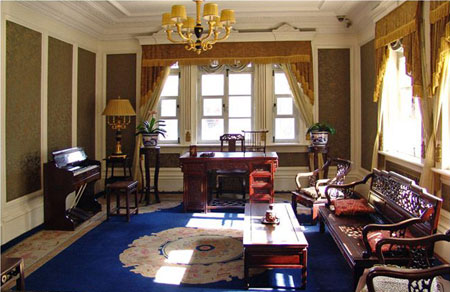
Exhibition
The exhibits in the museum have been set up in three sections: a display relating to the colonial state; a subject exhibition and finally, a display illustrating the daily lives of the Emperor and his concubines. Amongst the collection of important relics, there is a carpet from Jingren Palace in the Chinese Forbidden City, documents signed by Pu Yi and so on. The entire palace is surrounded by high walls, and there are about ten buildings in it.
For more information, please visit www.top-chinatour.com

Thursday, June 4, 2015

Jilin Provincial Museum

The Jilin Province Museum was established in sep.2003 with the official license awarded on Feb 14.2004, which is now under the leadership of Jilin Province department of culture. The current museum is a combination of the former Jilin Province Museum and the Modern History Museum, thus it is a comprehensive museum with history and art as its main characteristics.
Jilin Provincial Museum located in Changchun City, Jilin Province, covers an area of 2,000 square meters (about 21,528 square feet). The museum is built on the original palace site of the Emperor Pu Yi, last emperor of the Qing Dynasty (1644 - 1911) who later became a puppet emperor of Manchukuo during the Anti-Japanese war (1931 - 1945). The museum has many sections with exhibits from the Paleolithic Age (from 3,000,000 B.C.) and Neolithic Age (about 10,000 years ago) through the Yuan Dynasty (1271 - 1368) to the Qing Dynasty.
Among more than 2,000 exhibits, historic and cultural relics excavated in Jinlin Province predominate. Generally speaking, its range from Wangfutun Man in Prehistoric Times (one million years before) to the Opium War (1839 - 1842) reflects the historical development of Jinlin Province. Included is a collection of calligraphic masterpieces and paintings by famous Chinese poets and painters in ancient times. Works by painters such as Zhang Daqian and Qi Baishi, are also displayed.
The museum also searches for and gathers paintings handed down from ancient times but not collected by the Qing Dynasty government. Additionally, tourists can see jade, porcelain, bronze articles and lacquers. These items were excavated in Jilin Province: iron armor, a bronze board ornament, a pair of white jade earrings and a bronze harness of the Gaojuli People (a frontier ethnic people in northeast China), a bronze mirror with inscriptions of the Khitan People in the Liao Dynasty (916 - 1125), a purple glazed bowl of the Jing Dynasty (1115 - 1234) and a fresco facsimile from a princess's tomb. These relics conjure up images of the rich cultural development of Jinlin Province.
The museum exhibits glorious stories of Chinese heroes during the Anti-Japanese War (1937 - 1945). The heroes struggled courageously against Japanese aggressors in northeast China and sacrificed their lives for the liberation of their motherland. These stories reflect an unyielding and sublime spirit. The museum holds special displays of different themes. With its variety of relics, the museum attracts a constant flow of visitors from both home and abroad.
For more information, please visit www.top-chinatour.com